Before your AI builds it, check what already exists.
Every feature your agent writes from scratch costs tokens, time and new bugs. RepoHunter finds the maintained open-source version first and flags what to check before you install it.
claude mcp add repohunter -- uvx --from git+https://github.com/meetziggy/[email protected] repohunter-mcp
Write a hook that trims long command output. My Claude bill keeps climbing.
Checking what exists before writing anything.
- verdict
- GO 89/100
- status
- maintained · last push 2026-10-03
- license
- Apache-2.0
- fit
- runs easily · compiled, small footprint
rtk already does this. Installing it with brew install rtk instead of writing one.
What RepoHunter does
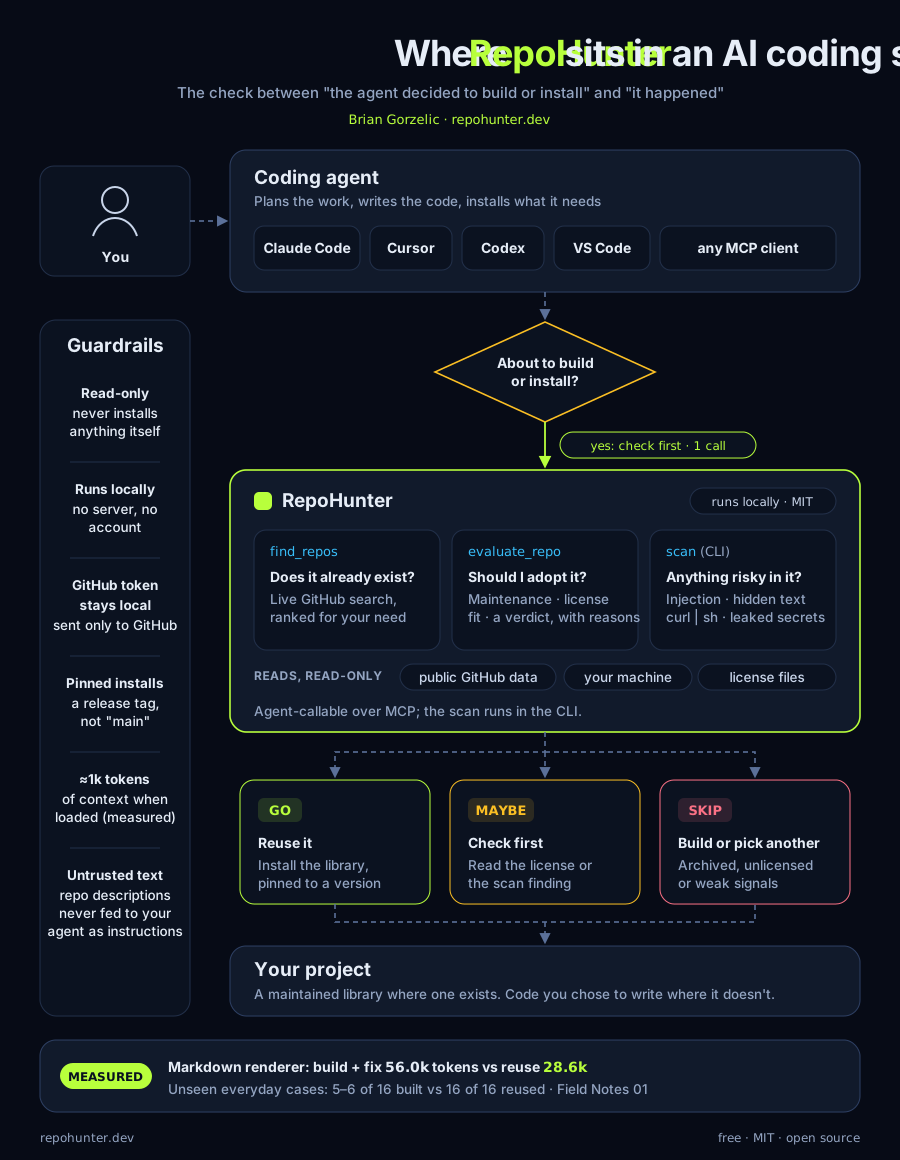
It sits between your agent's plan and the install. One question, asked every time: does a good version of this already exist, and is it safe to bring in?
Before your agent writes a component
Reuse beats regenerating once the job is real.
A from-scratch Markdown renderer passed 5–6 of 16 everyday cases; the reused library passed 16. Field Notes 01
Before you install agent tooling
Plugins, skills and MCP servers come from strangers.
rtk: GO, but its README installs by piping a script into your shell; use Homebrew instead.
Before you ship something you sell
Some popular repos aren't licensed for that.
context-mode: GitHub can't identify its license; the file is Elastic-2.0, source-available.
Researching a topic 0.3.0
Papers and free books, as a cited reading list.
arXiv and OpenAlex papers, plus public-domain books from Open Library and Project Gutenberg. Ships in the next release.
I tried to prove it saves tokens.
On small jobs, it didn't. On a real component, building it yourself cost about twice the tokens, and still did less. 23 agent runs, same model and tests, raw data included.
Read Field Notes 01Running agents on a team? I'll review what they depend on and load. See the audit or talk to me.
Why use RepoHunter instead of ChatGPT or Claude Code?
Use your assistant to reason and build; use RepoHunter for an adoption decision someone else can review. The full answer, including what isn't proven yet:
Use a general AI assistant to reason, explain, and help you build. Use RepoHunter when you need an open-source adoption decision tied to inspectable repository evidence, a consistent method, and a result someone else can review. They work well together: RepoHunter gathers and structures the evidence; you and your assistant decide what that evidence means for your project.
RepoHunter is read-only, shows the signals behind its guidance, and runs locally so you stay in control of your workflow. Missing or stale evidence should remain visible rather than being filled in with a confident guess. Its GO / MAYBE / SKIP result is a heuristic for a use case—not a security audit, a guarantee, or a verdict on a maintainer.
We do not yet claim RepoHunter is cheaper or faster. There is no controlled RepoHunter-versus-ChatGPT-or-Claude-Code benchmark yet. A defensible comparison must publish dated runs with wall-clock time, provider-reported tokens, tool calls, current prices, evidence completeness, and repeated-run consistency. Until then, the measured benefit is still an open question; the immediate value is a more reproducible, reviewable decision process.